Victory!
August 28, 2017: Signing of a full-funding grant agreement, covering $900 million in federal aid, and groundbreaking.
What is the Purple Line?
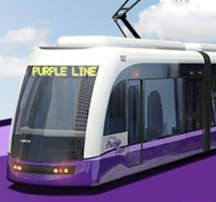
The Purple Line is a light rail line that will run parallel to the Capital Beltway to provide a missing cross-suburban mass transit link. It will connect suburban communities and job centers, providing a quality alternative to driving on the congested Beltway.
The line will serve the town centers of Bethesda, Silver Spring, Langley Park, College Park and New Carrollton, with two stops on the University of Maryland campus. It will tie together four Metro lines and three MARC commuter train lines. For detailed route maps, click here.
By linking major suburban centers and existing rail and bus lines, the Bethesda-to-New Carrollton light rail line will cut travel time for tens of thousands of area residents. For example, travel time from Langley Park to Bethesda will drop to about 22 minutes, far faster than is possible today by car or by bus. Trains will go between Silver Spring and Bethesda in 8½ minutes. Daily ridership on the Purple Line is projected to be 69,000 in 2030 and 74,500 in 2040.
This site offers 15 pages of information about the Purple Line. There are many benefits of the project. You can learn how the Purple Line will pass through East Silver Spring and how it will connect to the Red Line in Bethesda. You can learn the history of the project and read about alternatives put forward in the past by opponents of light rail. There is more detail about the Columbia Country Club and how it and other not-in-my-backyard opponents have spent money over the years to stop the Purple Line. We also have a collection of pictures of light rail around the world
Light Rail Around the World
Some scenes to get you thinking about the possibilities
Chronology of Purple Line Progress
On July 19, 2017, the U.S. Court of Appeals stayed the lower-court order, allowing Purple Line to go forward. ACT hailed the decision.
On August 3rd, 2016, U.S. District Court Judge Richard Leon handed down a decision that will halt the construction of the Purple Line. According to the Bethesda Beat, the judge demanded that a Supplemental Environmental Impact Statement (SEIS) be conducted before the project can proceed to construction, guaranteeing months of delay and jeopardizing the project.
The Purple Line construction contract closed June 18 after the concessionaire completed borrowing $1.2 billion.
Preliminary construction activities have started with utility relocation near the Bethesda station and demolition of houses on Riverdale Road in Riverdale.
On April 6, the Board of Public Works approved the contract with the concessionaire. ACT statement. Start of construction expected in late 2016, with trains running by March 2022.
On March 2, 2016, Governor Larry Hogan announced Purple Line Transit Partners as the concessionaire for the Purple Line.
A plan to replace the building above the future Bethesda station to provide a wider station platform and avoid having riders walk across the tracks was revived when Carr Properties purchased the existing building.
At a Sept. 9, 2015 council meeting, the Town of Chevy Chase decided to end its active opposition to the Purple Line and work cooperatively with the Maryland Transportation Administration to resolve concerns about the line's design.
On June 25, Governor Hogan announced that the Purple Line will go forward, conditional on cost cuts and increased financial contributions by Montgomery and Prince George's Counties and the private contractor that will build and operate the line.
Study finds Purple Line will have vast economic benefits.
On February 2, ACT sued the Town of Chevy Chase over secrecy in its lobbying campaign against Purple Line.
Montgomery County Council joins Planning Board in reaffirming Purple Line as county's #1 transportation priority.
The 2015 omnibus spending bill passed by Congress included $100 million in Purple Line construction funding.
In August 2014, U.S. Fish and Wildlife Service and ACT's Ben Ross debunk claims that Purple Line will harm endangered species of tiny crustaceans. Researchers hired by Purple Line opponents subsequently find that amphipods living in an old railroad embankment are not the endangered species, yet continue to pursue lawsuit against the light rail line.
On July 28, 2014, MTA issues its Request for Proposals to four qualified bidders to build and operate the Purple Line.
Federal Transit Administration signs Record of Decision approving environmental impact statement.
Federal Transit Administration recommends $900 million federal construction funding. President's 2015 budget includes $100 million first installment.
The Maryland Open Meetings Compliance Board rules that the Town of Chevy Chase broke the law when it hired the brother of Bill Shuster, chairman of the U.S. House of Representatives Transportation and Infrastructure committee, to lobby against the Purple Line.
Six teams compete for contract to build and operate Purple Line.
On Nov. 6, 2013, the Maryland Board of Public Works approved a Public-Private Partnership approach to building and operating the Purple Line.
The Final Environmental Impact Statement was issued on Sept. 6, 2013.
In May and August 2013, Maryland committed $680 million of new gas tax money for final design and construction of the Purple Line, bringing the total state commitment to $900 million.
In June 2013, the main opponent of the Purple Line, Columbia Country Club, agreed not to oppose the project further in any way. An exchange of real estate will move the light rail tracks 12 feet to the side and allow the country club's golf course to keep tees at the most desirable locations.
The Purple Line will replace two traffic lanes on University Boulevard instead of widening the roadway. A dangerous highway will become a place that welcomes pedestrians and transit riders.
Rezoning may allow bigger Bethesda station, with bike trail going under Wisconsin Avenue.
On March 29, 2013, Maryland legislature passes transportation funding bill that will fund the state's share of the cost of the Purple Line.
Sierra Club hails Purple Line as one of 25 best transportation projects in the U.S.
Prince George's County leaders rally for the Purple Line.
The future Bethesda Purple Line station will be accessible from the bike trail on both sides of Wisconsin Avenue. Trail users will be able to walk all the way through the tunnel.
Absence of the Purple Line brings crime to Chevy Chase in the summer of 2012.
On March 13, 2012, the County Council voted to keep the new Bethesda metro entrance in the budget. To pay for it, the county will delay two upcounty road projects designed to support sprawl development. The only councilmembers speaking against this switch were Craig Rice and Marc Elrich.
The Purple Line will go from Bethesda to Silver Spring in eight and a half minutes.
The Purple Line was approved in October 2011 to enter preliminary engineering by the Federal Transit Administration. This is the final federal approval of the mode (light rail rather than bus) and route of the project. The project got a “medium-high” rating, putting it ahead of most competitors for federal funding. Read ACT's press release here.
The Maryland Transit Administration has redesigned the area around the future Lyttonsville station to reverse the location of tracks and maintenance yards. There have been complaints from nearby residents, but a detailed analysis in the Silver Spring Trails blog concludes that the changes will benefit neighbors on balance.
The University of Maryland goes all out in support of the Purple Line. President Wallace Loh says that without light rail “There's no way we can retain faculty... It's either massive gridlock or the Purple Line.”
Purple Line schedule slips two years; construction now will begin in 2015 and end in 2020. Cost estimates largely unchanged, but adjusted upward to $1.925 billion to reflect two more years of inflation.
The Town of of Chevy Chase appears to back off its long-standing opposition to the Purple Line. Town council members say they will work with the Maryland Transit Administration on the Purple Line and are unlikely to sue to block it.
A new vision emerges for a walkable Chevy Chase Lake around the future Purple Line stop.
Governor Martin O'Malley's strong re-election victory, propelled by wide margins in Montgomery and Prince George's Counties, is seen as a victory for the Purple Line. For a summary of where the candidates stood, see our comparison page. (Spanish version here.)
The Maryland Transit Administration now favors a Purple Line stop at Dale Drive and Wayne Avenue and has asked the county to endorse adding this additional stop. Tina Slater, ACT Vice President, testified before the County Council on why the Purple Line should stop at Dale Drive.
The state's plan for the Purple Line, including a double track rail line between Bethesda and Langley Park, is now officially part of Montgomery County's master plan after a unanimous vote by the County Council on July 27, 2010. Earlier, the Montgomery County Planning Board approved the Purple Line Master Plan at its April 8, 2010 meeting. See the Silver Spring Trails blog for background on tweaks made by the Planning Board.
Read the revelations about the money spent by Purple Line opponents.
The Draft Environmental Impact Statement for the Purple Line was released on Friday, Oct 17, 2008. Read ACT's comments.
For earlier history, go to our Purple Line history page.